We all loved Wister. He was Amy McCarthy's faithful friend who followed her and Forrest to the tops of a hundred peaks and down a thousand trails. For the past few summers Wister had led me to the top of Taylor Mountain, the southernmost peak in the Teton Range. We had our routines: stopping at the last stream in a meadow blooming of lupine, geranium, daisy, and arnica. Wister would flop belly down into the small brook and cool off before the steep ascent up the peak. Half way up he would find a snowdrift for the second cooling; and at the top he took a drink from my water bottle before heading down.
I was in Jackson Hole to help make a movie, and at the fundraiser, Amy asked if I would climb Mount Wister with her and spread a few ashes on the summit. Our long-time friends Yvon and Malinda Chouinard were also there, and Amy invited them too. We would pick them up at 6:00 am; Amy's friend Kim Young would meet us at the trailhead, making a perfect hiking team.
We were on the trail before first light, and as we walked up past the Taggart pasture and tack shop, memories flooded back from the first year I was a park ranger and bunked at remains of the ancient Taggart Ranch lodge. Each morning I would walk out to the barn, feed a stack of hay to the horses and fatten a few with a coffee-can of oats. Then I'd walk the pasture and change the canvas dams for irrigation. All before reporting to work at the Fire Cache at 8:00. Today a sprinkler system sprays mist into the cold dawn.
Up the trail we cross Taggart Creek on a nice bridge, then head west to the lake. The first sunlight hits the top of the Grand Teton while we are still in the cool, almost frosty air, a mist rising from the creek. Yvon, Malinda, Amy, and Kim appropriately wear Patagonia down sweaters; I'm in a white nylon shirt and feel the cold, but the brisk pace keeps me warm.

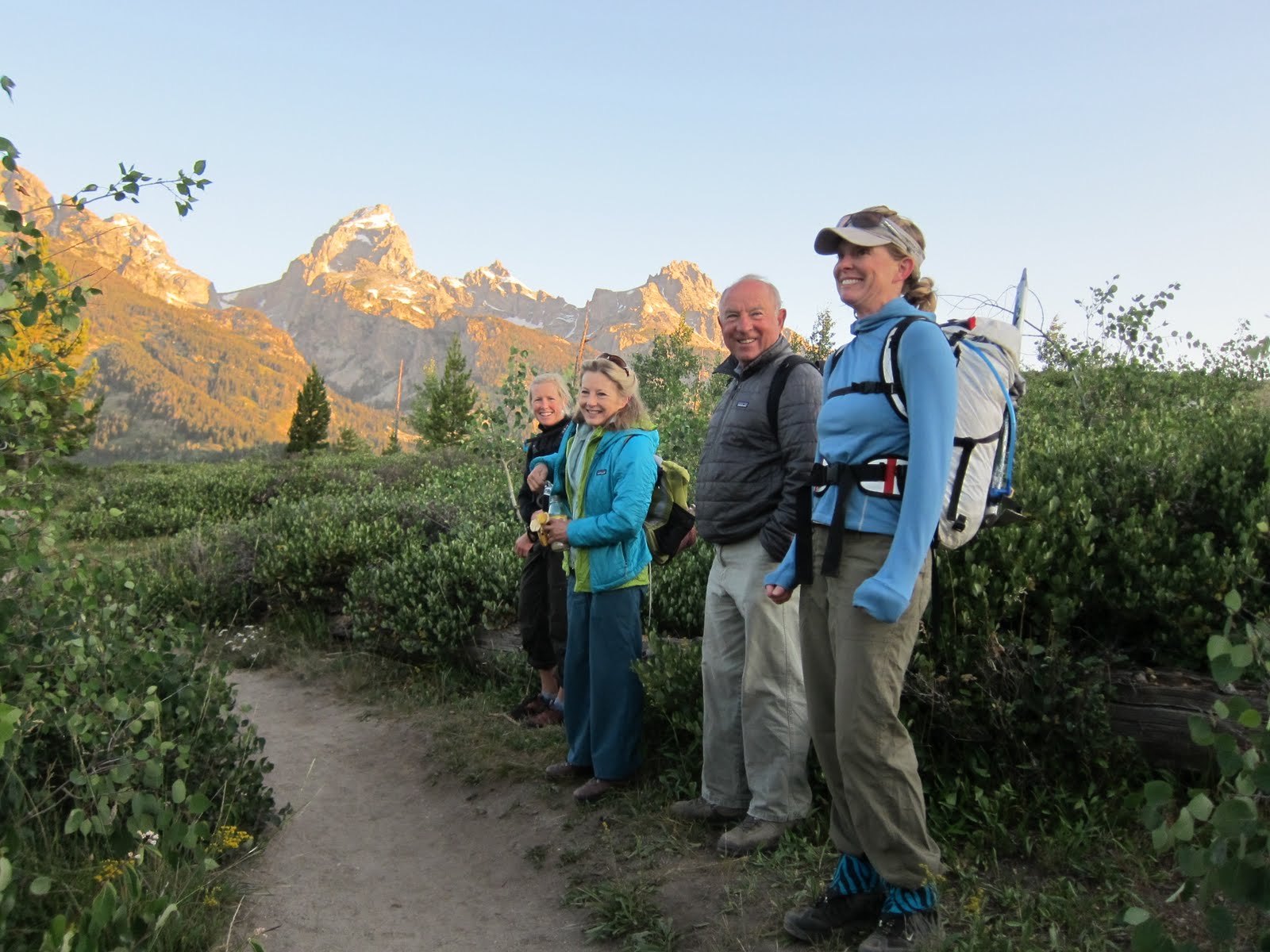
I ask the group to stop for a photo when the sun turns the Tetons to gold. We're all smiles. The conversation turns to trapping: Malinda wants me to tell the story of how I trapped Jack Dornan's cat, 'Kitty Blue' in my skunk trap and of letting it out at Schwabacher's Landing and unsuccessfully chasing it through the sagebrush calling "Kitty Blue! Kitty Blue!". Now the tall tales begin. We are laughing at Yvon's stories, then Malinda's. The day is off to a great start.

It's about a mile and half to the Lake, and when the lake comes into view there's not a breath of wind, and the reflection of Avalanche Divide and Mount Wister are mirrored off the water. Our goal is directly ahead, but many miles and 5,000' feet away. Suddenly my back feels wet; I flip off my backpack which is now full of water from a leaking container. Everything is wet, so I dump out the pack and announce that I have a refrigerated pack and shirt to keep me cool through the heat of the day.

Another mile and a half around the lake we start to lose the trail and enter a rain forest full of ferns, cow parsnip, and nettles, similar to where I would hike in Alaska. Malinda wisely notices that it is time to turn around if she is to wend her way home alone in time for her day's work.

The unmaintained trail narrows, downed logs cross our path and we need to climb over them. Every now and then we lose the trace and search for it. A boulder field, my least favorite form of trail is suddenly in our path. We're spry and make our way, catching the track again.

We four plod on. I'm already warm, so I take off the thin long-sleeved shirt and put on a blousy short-sleeved one for the rest of the day. The canyon seems long and steeper than I remember. The noise of the creek drowns some of the conversation, but likely the exertion has also slowed the hot air. Near the forks of the canyon, Yvon spies a massive glacial boulder with a huge crack running up the center. "Jim Donini would love this, wouldn't he?", Yvon states, then cruises over to size it up for a climb.

Looking up from the forks we can see Taminah Falls spilling out of the lake. I know it's still a grunt just to get there, and the air is warming up on this clear morning. Mount Wister, named for Owen Wister, who lived in the Valley a century ago and author of "The Virginian", rises on the left. On the right is Nez Perce, the Howling Dog. To the west is the skyline ridge of Gilkey Tower, Cloudveil Dome, Ice Cream Cone, and The South Teton. Amy asks Yvon if he has any 'First Ascents' here. He tells the story of how he and Rick Black climbed the first and only ascent of the South Face of Cloudveil. "The hardest pitch of a first ascent I ever led: 5.11. Rick was belaying, so after I climbed the overhang, I told him to rappel down." Later he points to two buttresses that look like magnificent climbing. "I climbed a line on each of those. I doubt anyone has ever repeated them. Good rock, but it's too tough to hike in here." I know what he means.

It's been a late spring and summer in the Tetons. No brown yet; lots of snow and green everywhere. I photograph tons of flowers: bright red Indian paintbrush, yellow cinquefoil, blue monkshood, purple penstemon, arnica, yarrow, lupine. The flowers of spring are blooming in late August after the largest dump of snow on record. The mountains are still spilling over with snowfields, and the rivers are high.

We have gained about 1,500' of elevation up to where Avalanche Canyon forks. Straight ahead was Taminah Falls. We climbed up the steep scree slope to the north. Amy and Kim sprinted ahead, while Yvon and I contemplated the flora. The cliffs around the falls are difficult, so we climbed above and dropped down to the lake shore.

Mount Wister now appeared and we could choose a route to the top: the snow couloir leading up the saddle, then west up the east ridge.
At the lake edge we sat down for lunch. Yvon talked about his ideas and plans for the future of Patagonia. Each of us expressed our preference for mountain foods. It ran the gamut from Mojo bars to canned salmon to sandwiches. Real food was the winner!

Amy asked if I would like her to take a photo of me. Very cool, since I have few photos of myself. My first mountain patrol as a ranger was up Avalanche Canyon a zillion years ago. In those days many of my patrols were done solo; there were only 4 Jenny Lake Rangers, and with station duty and days off, we never had a chance to patrol together. I thought back those many years and remembered searching for a path through the forest and climbing the scree to the lake where I set my little Exa camera on a rock and took a self portrait, the only photo I have of myself from that year. I'm smiling at the camera wearing a ranger shirt, badge, Levis, and no hat, my short blond hair whitened by the summer sun. I thought of that photo several times during the day. This one is so totally different: I look like a lost tourist from Florida. Same child-like enthusiasm for the mountains underneath.

Kim started out and found a logjam across the outlet stream. We followed and fought our way through the thick spruce and willows to the south side of the canyon and up the rocks to the snow couloir.

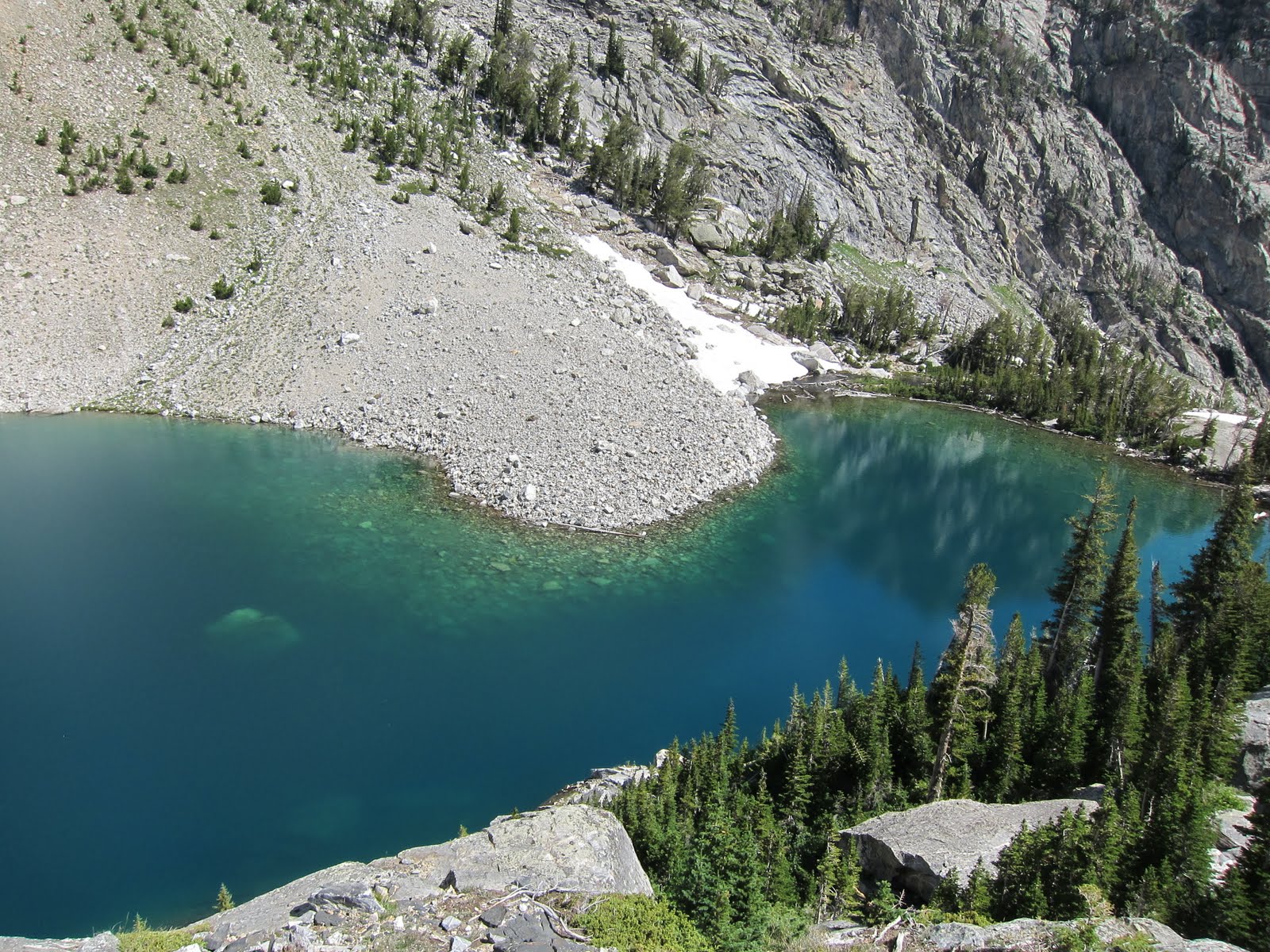
Looking back down on Taminah Lake, it is so clear we see huge boulders and talus spilled to the bottom.

Ahead the North Face of Wister looks smooth. Yvon tells us that Layton Kor, the great climber of the 50's and 60's put up a route there. As a rescue ranger I am reminded of the deaths, the accidents, and rescues all over the range. On this north face I see the fallen climber of 35 years ago and remember scrambling all over the mountain, including the north face unroped looking for any clue to his disappearance. I mention this, and immediately regret saying anything that would taint the joyous mood we have cultivated all day. I can't help it. Part of me is this sad past. I look up again and Amy is taking my photo. My spirits soar.

Amy is all smiles, the most cheerful person I've ever known. She tended bar at Dornans in Moose for 12 years and knows everyone in Jackson Hole. Amy is now the director of the Teton Raptor Center in Wilson, Wyoming. Her husband Forrest, Public Lands Director for the Winter Wildlands Alliance and mountain guide, is one of my best friends. She and Kim move gracefully up the snow for a ways, then Kim pulls out a pair of crampons as the slope steepens. Amy, Yvon, and I kick steps with our soft approach shoes. As we head up the hill, a spontaneous rockfall starts from the huge scree slope above the snow. Baseball and larger sized rocks come hurtling towards us. Amy and Kim skip to the side. Yvon and I are lower and are in the firing line. It's a tense minute as more rocks come and spread out like a shotgun blast at us. I finally sprint to the left to avoid a volley. Yvon holds his ground waiting to jump at the last minute. All clear, and we head to the left edge to avoid any more rocks.
At noon, Kim has to turn around in order to make it back to Jackson in time for afternoon obligations. A tinge of regret flows through me as I see her disappear to a dot down the snow slope, since she and Amy were so delightful together all morning. The snow steepens. We hit the huge scree slope, but it's dirt and rubble. Nothing holds together, and we make only a foot of progress for every two steps. We climb close together and at each others' sides, because every step sends scree down the hill. We all agree it might be one of the worst rubble slopes ever. Who talked me into this???

Yvon has picked up a walking stick somewhere in the forest. Amy has brought us each an ice ax; I feel like I'm cheating using it next to Yvon and his stick. He is likely envying my ice ax. As the slope turns to ice and snow again, Amy leads out kicking all the steps and doing all the work. I chop the steps bigger for the possible descent in the cold afternoon. If we come back this way it will be dangerous unless the holds are big. I'm planning ahead, since a fall could be disastrous.

We are almost to the little saddle. Looking down the snowslope, it appears even steeper from above. They always look foreshortened from below. Yvon's picture gives a sense of scale.

We take a quick break for food and water at the saddle. The north face of Buck mountain is directly across. I break my rule and start to tell of a tragic accident on the face in the mid-'70's. I apologize and change the subject. The sun is warm, the Mojo bar was tasty, and I rehydrate with water brought from the lake. I've never treated water in the Tetons; I know others do. Maybe I'm immune after all these years.

We start the rock climb up the ridge. Amy is on the rock first, firing up the pitch. I call out that we do have a rope if anyone needs it. Hmmm! Amy doesn't. I don't, and certainly Yvon wouldn't. As we touch the rock my fingers feel the warmth, and I remember the first words of French I translated from Gaston Rebuffat's "Neige et Roc" when I was a young boy: "The touch of good granite is agreeable and reassuring."

The rock steepens. Yvon packs the walking stick in the loops of his backpack. Amy is moving quickly up the rock. The granite seems to be full of holds; it's a joy! Amy comments that this is her favorite type of climbing: good steep rock, solid, exposed...

Amy smiles and waits for us again. Yvon and I have been at sea level for a long time, so the 11,000' air is a bit thin. We set a slow pace, but move up confidently. I love the feeling of putting my hand on a hold, gripping tightly and moving up on my feet. It doesn't get any better than this with my two fine companions.

I look straight down at Yvon climbing smoothly up the rock face and think of the thousands of peaks he's climbed: El Capitan, Half Dome, Fitzroy, the north face of the Crooked Thumb. Everywhere! What a privilege to be in his company today.

Yvon pops over the cliff edge. We take a mini-break and drink some water. It's so easy to dehydrate at this elevation in the dry air, and exerting in the sun the way we are. Life is good!

The route curves to the right up a knife edged ridge. The rock is good, but a fall on either side would be bad. I have my camera out half the time, wanting to remember every second of this climb.

Amy looks up and announces that we are near the summit. That's good news; it's been a long day. We scramble the few remaining feet to the top where a huge vista appears from every direction.

Looking down the ridge we can see Avalanche Canyon, the knife-edged ridge running from the South Teton to Nez Perce. To the east Jackson Hole, the Gros Ventre range, and beyond that, the Wind River range. To the south the enormous north face of Buck Mountain. To the west, Victor and Driggs, Idaho. And on the north, the Grand Teton sits above everything.
Amy scatters some of Wister's ashes. He's been deposited on many summits, including Gannett Peak, the highest in Wyoming where he made six ascents. Wister the Uber-Mountain Dog!
 Neither Yvon nor I had been to the summit of Wister; Amy had been here 13 years ago. Over the years I'd crawled all over the mountain looking for a lost climber, but never touched the summit. Another Teton peak bagged!
I ask Yvon if he wants to call Malinda. He's intrigued that we get cell reception on the summit, so I dial Malinda and joke about the Geezers on top. It's 3 pm, so she knows we won't be home for a long time. We chat, and as I look around I see a huge thunderstorm coming at us from the southwest. It looks a half hour or more away, but we need to get out of here.

We climb down the east ridge the way we ascended. At the knife-edge arete Yvon looks down the steep couloir and asks if it looks like a good descent route. We check it out and all agree it does, and it eliminates the need to descend the hard afternoon snow gully we climbed in the morning. It's a much safer alternative. Scrambling down isn't hard, but there is a massive amount of loose rock and dirt everywhere. We stay close together, so a dislodged rock doesn't hit one of the others.

About a third of the way down the gully, my foot slips on a loose boulder and I twist down hard, slamming my right knee into a sharp rock. The pain is severe, and I worry that I've just severed my ACL or torn a meniscus. I can still walk, but slowly. We keep up a pace to get out of the gully before the storm hits. The thunder drum rolls begin just as we hit the snowfields at the bottom. Only a few raindrops pelt us, and since we are so hot from the exertion, we continue moving. I'm the slow one, but Amy and Yvon wait for me periodically.

The south fork of Avalanche Canyon, a new vista in the Tetons opens up. I thought I'd visited every canyon in the range. There is no sign of another human being: no campfire rings, no trails, no tin cans or candy wrappers. Now the adventure is truly complete. The only problem is that my bum knee isn't much fun.

Amy stops at the foot of the snowfield below a huge waterfall as the canyon turns north. It's time for a dinner snack: more pizza and another Mojo bar. The icy water is what I want, burbling out into a small stream from under the snow. It's a great treat, and I stand up refreshed. My knee has frozen up, and it takes a minute of walking before I'm loose enough to hop and jump down the boulder field. We walk through a beautiful meadow, but are stopped by a thick krumholtz. I cross the stream on mossy boulders to go down the opposite side, however Yvon and Amy have already picked a faster route. I hurry, cross the stream at the bottom near a huge swamp and join them on the left side. We find a trace of a bear trail and continue down. Where is the end? We look down another thousand feet of scree and boulders to the main floor of Avalanche canyon and pick our route.

The creek has broken into a number of smaller channels, each one negotiable as we make our way to the faint trail we came up on. Almost as we see it, we disturb a cow and calf moose about 50 yards away. We worry about the cow, so we bush-whack for another fifty yards or so through willows and swamp to avoid them and hit the trail very near the huge boulder with the crack. We are back on track.

It seems interminable. I get into the "zone" and set a pace out, Amy and Yvon behind me, since I'm likely the slow one tonight. We make good time, and before the sun has set, we see the reflection of Taggart Lake in the distance. The thunderstorm has moved east, and we see the lightning striking the Gros Ventre range. (In the morning a plume of smoke rises from behind the Sleeping Indian mountain to the east of Jackson Hole.)

Down the trail, around the lake, onto the flats. Now it's almost dark, and we slow a bit to make sure we don't stumble on unseen boulders in the trail.
We drive into the Chouinard's yard at dark. Melinda has home-made soup on the stove for us. After a beat-out like today, it's the perfect food. Melinda has done her hair, and we all comment on it. She sees my bum knee, heads to the fridge, pulls out an ice pack and wraps my knee, feeds me Ibuprofen, and elevates the leg on a chair. I'm in good hands. Yvon and I are beat. Amy still has her great smile.
 After a couple of miles along a very well maintained flat trail, crossing Campbell Creek, the trail forks uphill towards the peak. Up till now I had been cruising at a good clip. In spite of the knee, I hadn't lost much of my precious conditioning.
 Up I went through the spruce and birch forest, the trail still a bit muddy and slick from a week of wet weather. I've been here before and power up the steepening trail, hoping for my first unobstructed view of the mountains. Soon I break out above treeline into the sub-arctic tundra. It is definitely autumn here: all the plants have changed color. Seeds litter the ground from the sedges, grasses and flowers along the trail. Suddenly I see a beautiful blue harebell. What are you doing blooming at this time of year??? The rest of the plant world is going to seed and shedding its leaves.
 The broad expanse of the tundra stretches ahead; Wolverine Peak looks more distant than when I started. The trail heads straight up with no switchbacks. The sky is pretty black, a breeze is blowing, and the weather report is for rain. "Strong winds to 70 MPH on Turnagain Arm and on the hillside" was the weather report on the radio this morning. Hmmmm! I see the clouds scud by at a fairly good clip. The only blue sky in hundreds of miles is directly over Wolverine. I'm sure it's just a sucker hole, but it lures me upward.
 This whole landscape is the product of continental glaciers that receded as recently as 10,000 years ago. The valleys are U-shaped where the glaciers gouged them out. Even the tremendous Susitna Valley stretching from Mount McKinley south through Cook Inlet was filled to thousands of feet with ice. I look on the ground and see granite boulders. "No granite in the Chugach", I say. These rocks were transported south either 40 miles from the Talkeetna Mountains, or a hundred miles from the Alaska range and deposited 4,000 feet high on the ridges of this peak. I look out and see a huge granite erratic stuck in the ground.
 Two hours on the trail, and I've covered nearly five miles uphill. The summit and the speck of blue sky are now within reach. I'm on a ridge leading to it, but as I reach it, the wind hits me in the back. It's stiff, maybe 20 knots. And it's coming from the wrong direction; well, not really. It's the rotor wind blowing back like an eddy in the river as the more powerful wind flows over the summit, then drops over the summit and washes back at me. I'm wearing a thin cotton shirt, and although the temperature is in the fifties and I'm working hard, my temperature drops. Gusts increase as I move uphill. I have a jacket in my daypack, but I'm reluctant to put it on; I'm sweating and think I'll just sweat harder with the coat.
 The ground is composed of the granite and limestone rocks from afar, signs that this was part of the glacial outwash. I'm still amazed that the foreign stones are so high up this mountain and try to picture the ice over a mile thick flowing through here. Then I remember my days on Mount McKinley (Denali), where even today on the Kahiltna Glacier, the ice measures a mile thick.
 Searching the ground, the dogwood that was so recently in bloom with little white flowers and green leaves, now sports red leaves and orange berries.
 I'm now well up the peak, and the wind has increased against my back, maybe 40 knots. I lean back, and am blown uphill. Looking down the cliff I see the remains of a crashed helicopter, it's twisted hulk like an extinct dinosaur, so out of place here. But it's on to the summit; no turning back now, no matter what the weather. Suddenly, a gust blows me back a few feet, and I lean into the wind. I'm on the summit ridge, looking down the cliff to the north. Wind is coming from every direction. I can't believe this is the only patch of blue anywhere, and it has stayed in this spot for hours. My ball cap goes into the pack. I'm afraid it will be blown off to the next valley. I have a little wool hat in the pack and a pair of light gloves. The wind is rocketing off the rocks, knocking me around like a rag doll. "The summit at all costs", I say. Once on Mount Dickey with a bunch of life-long friends, I was leading the charge to the summit, and one asked Thor, my son, "Is he always like this?"
  I look north: it's raining, and the distant mountains are dim. I'm in my element and couldn't be happier. I stop to take a photo and move on.
 The summit is almost calm. I put my cap back on, take a photo, grab a drink of water and nibble a bit of my peanut butter sandwich. I can't stand all the energy bars: most taste like compressed sawdust. The best are regular candy bars; my favorite are Snickers and Payday, because they have lots of nuts. But mostly I bring a good sandwich and an apple. I've found I have more long-lasting energy with real food.
 To the west, Cook Inlet, and Anchorage. It's a long way down, so I don't tarry on the summit too long. The wind will be in my face. I jump down the trail, full of energy. My coat like a sail as I lean into the wind and float down the mountain.
 My only stop is to look at another willow plant, that is now bright yellow next to its red cousin. Looking across the tundra, it predominates and gives the ground its tan and yellow hue.
 Further down, the wind is pushing the krumholtz flat. I know it's a powerful blow, but not uncommon here. It has shaped the vegetation and this landscape over the years. I'm flying down the mountain at high speed, but I worry that I'll be sore tomorrow. "I'm too old for this", I say to myself as I slow to a trot. "The Hell with it", and I break into a little run straight down the hillside. "I can make it to the car in half the time I hiked up", I tell myself as a little race begins.
  Soon I'm back on the flat, racing to the car to meet my goal. Suddenly a huge split birch tree is right in front of me. I'm retired! I'm in no hurry. So I stop, look at the tree for a minute, fish out my camera and take it's picture. What a great day!!