Friday, May 17, 2013

Hiking Rancho La Laguna

My last full day in Santa Barbara, and Nori had arranged for us to go on a hike with her hiking club, a wonderful group of friends whom she wanted me to meet.  Steven Sharpe, General Director of Opera Santa Barbara had organized the outing and arranged for us to meet downtown at 6:45 and carpool up to the ranch for the hike.
Looking back down the trail on the Preserve
Rancho La Laguna, nowdays called the Sedgwick ranch for the previous owner, sits in a valley northeast of the little town of Los Olivos, and abuts Michael Jackson's "Neverland" ranch.  The property dates from a land grant from the mid-1800's before California was a state.  However, today it is a research facility for the University of California, Santa Barbara.  Duke Sedgwick willed the property to the university on his death.  Fairly large at 6,000 acres, it is full of deer, bear, coyotes, and mountain lions.  The country driving in was dry and brown, but as we ascended the canyons, pines, junipers, and other trees greened up the scenery.  Living in the sub-Arctic most of my life, I don't relish hot days, and as the thermometer climbed to 97 F., I wondered what I'd gotten myself into.

We met our guide for the day, Kate McCurdy, director of the UCSB Sedgwick Reserve in Santa Ynez. I might not have been the oldest hiker in the group, but most weren't kids, so I thought I'd be in good company.  Steven was full of energy, made introductions, and herded us to the start, a dirt road through dry June grass, the stuff that sticks in you shoes and socks.  We walked single file uphill, dripping sweat and chatting.  Most of the folks were in fine shape and kept the pace brisk. 
Heading uphill
I honed in on Kate to see what kind of research was done there, so I hustled to the front of the line.  Surprise, Kate had been a National Park Service researcher in Glacier National Park, Yosemite, and Santa Monica Mountains.  She talked about her grizzly bear research in Glacier, and I remembered attending a conference where Kate Kendall, presented the results of their research on grizzly DNA.  She pointed out the great fault dividing the rocks and soil types: the Paso Robles alluvium and serpentine rocks from the Franciscan formation.  The vegetation uphill from the fault are composed of native species, because the soil in not as hospitable to the invasive species, so the geology is often studied at the preserve.  Kate and I reminisced about our days in the National Park Service, mutual friends, and the research at the preserve.  But, I felt I was monopolizing her brief time with the group, so I dropped back to sweat with the rest of the gang.
Kate educates the group
I had thought we would be taking a leisurely walk with educational talks, so I brought heavy binoculars for birding, and my SLR camera...and a bottle of water.  The gear hang heavily around my neck, so after taking a few photos of the group I put it in my pack so I could hike at a brisk pace.  

 Nori tops out on the grassy hillside
We had gone a couple of miles through the forest and canyon, finally emerging on a grass-covered ridge overlooking the ranch.  The trail had disappeared, so our feet scuffed through the grass picking up prickers and chaff.  At the top an outcropping of rock gave a great view of the area.  I thought of the coyotes that scouted from here while digesting dinner.  Ravens were the only birds out in this heat.
Nori and I stand on top of the rock overlooking the ranch
Down, down, down the steep slope to the canyon.  At the forks near our cars some of the group who had prior engagements split off, but we followed Kate for a few more miles back up another canyon, over a divide, and through more canyons and forests before returning the the cars.  

The gang had planned a potluck lunch, and I stuffed myself more than usual sampling every dish.  I sat next to Dr. Peter Nickel and his wife Carrie Garner who had invited us to dinner the previous week.  It's a small world: he knew my friend Dr. Debbie Wheeler, an anesthesiologist living here in Ridgway and a ski partner for the past several years.  They had worked together in Denver years before.  

Sitting under the 400-year old oak tree I thought of what this country might have looked like a couple of hundred years before when the Chumash natives lived here and the trees were larger, the vegetation all native, and very few people.  Tomorrow we would drive through L.A. and deposit me at the airport.  It is truly another world out there.


Thursday, May 16, 2013

Biking & Wine

There are hundreds of fine bicycle tours through California wine country.  Some are organized; some, like ours are spur of the moment, seat of the pants tours.  Nori suggested riding the roads from Solvang to Los Olivos, so we squeezed our bikes into the back of her Volvo and headed up Hwy 154 from Santa Barbara to Solvang.  The coastal ecology changed radically as we powered up the curves out of Santa Barbara.  Looking back on the red tile roofs, whitewashed adobe, and misty ocean, I noticed how quickly the climate and vegetation changed to the tinder-dry grass and shrubs of the inland.  I remembered reading E.O. Wilson's "Biodiversity".  He told that the most threatened ecosystems in the world were those along the California coastline.  Almost every plant is an exotic brought from Africa, Asia, and beyond. The local plants are almost all gone.

It was a chilly 54 degrees, so we walked around the little Danish-motif town like tourists, peering into a dozen stores: pastries, bamboo clothing, antiques, restaurants...  I'd lived in resort towns and national parks most of my life, so it seemed a bit too much for me, but fun for a tourist.

Once on the bikes we pedaled up towards Los Olivos into the heart of the wine country. 

Or should I say, wine tasting country.  Every driveway we passed advertised wine tasting.  Once in the little town we tied our bikes to a sign and walked the streets.  Almost every store, home, or building had been converted into a wine-tasting bar. 


Nori strolls by the Byron tasting room

A well-fed calico cat soaks up the sun in the window
We popped our heads in several small shops but decided riding a bike on the highway while tipsy might not be the best idea.  However we noticed a number of gold medals hanging on one shop, so we decided to do a 3-wine tasting at Daniel Gehrs.  The proprietor poured three whites: The Chardonnay was delicious, and as I sipped the drops, the fellow explained that Mr. Gehrs ferments the grapes in stainless steel vats, not in oak barrels, so the taste is clean and bright.  Thinking back on my beloved Bordeaux wines, I'm probably a romantic who cherishes the subtle flavors of the oak.  Wine should have heart and soul, a bit of magic, so the chemically pure taste seemed to be missing something.  He described the Chenin Blanc as "buttery", and I agreed.  It swirled in my mouth not unlike a fine olive oil.  We learned that Gehrs does not own any vineyards but buys the grapes and makes boutique wines.  Not sure what to make of this, I lifted the Riesling to my lips.  Much sweeter, like the German wines I love.  If I want a Riesling, I always buy the German ones, but this gave me a very sharp, clean vision of a fine wine.  We left the shop after about an ounce of wine and didn't feel a thing.  Perfect!

On around the block to a little nursery and yard ornament shop, full of Buddhas, ferns, flowers, vases, and odd stuff that I'd be unlikely to find anywhere else.  The over-stuffed clutter gave me some ideas for landscaping my new yard. 

Right now it's mostly mud and weeds, no lawn, no grass, and a pile of sandstone rocks the builder left in the front yard.  I've been thinking of making them into a fountain for the birds.  However, I couldn't see a contemplating Buddha staring up my walk.

We took off out of town on the bikes, rode on some backroads, then down into Solvang.  I had originally thought of the bike ride as physical exercise, but up till now it had been a cultural experience.  With the breeze on my face and my leg muscles pumping, it felt good to be back on the bike and exercising.  I thought ahead to home and getting on my bike again now that spring had come to the Rockies.

Nori suggested we have lunch at the "Cold Spring Tavern", an old stage coach stop near the top of the pass.  She promised a beer, fine food, and another cultural experience.  Since 1865 The Cold Spring Tavern has been serving travelers over San Marcos pass.  It was on a little side road, originally the main road from Santa Barbara to the high country.  Huge trees shaded the tavern.  A busload of tourists stopped just as we did, so we sprinted for the door.  Just in time, since it closed at 3pm. 

One waitress did everything, and we were impressed at her efficiency.  She brought us a pile of home-made onion rings that Nori had recommended; then Nori ordered the salad, I opted for the hamburger and a pint of Hoppy Poppy IPA. 
By now we were the only people in the tavern, so I looked around a bit and took a few photos of the dusty old fireplace and memorabilia on the walls.


I managed to force down the entire burger, the large IPA, the onion rings, and a potato salad along with Nori's bread.  I waddled to the car and lapsed into a food coma as Nori drove down the hill to home. So much for a day of exercise on the bike.

Wednesday, May 8, 2013

Daphne Visits Santa Barbara

Nori has a beautiful home in Santa Barbara where she spends the "Mud Months in the spring and fall each year.  I had been invited to visit, and when I mentioned it to my daughter Daphne, she said she would be in Los Angeles the previous few days and we could meet, drive up to Santa Barbara, and spend a few days together with Nori.

The Hungry Cat is famous for seafood, a little gem tucked into the wall at Sunset and Vine in Hollywood.  Daphne had discovered it online and recommended we meet there.  I took a cab from LAX, a ride that cost me more than my plane ticket from Grand Junction to Los Angeles...what a surprise.  My heart raced when I saw Daphne approach; we hugged and immediately got to the gossip of the past month, the cuisine, her seminar at Agape, and life on the East Coast.  For a woman born and raised in a log cabin in Alaska and an Inupiat village in the Arctic, she has transitioned into the culture, music, and arts, and theater.
We started off with fresh oysters on the half-shell with three sauces.  Daphne had a salad, I some decadent fish dish.  It's hard to remember, since I was so delighted to see her again.  I live in Ridgway, Colorado, many miles from Jersey City & Manhattan.  But it's closer than I used to be: 32 years in Alaska.
Daphne and I with the Hollywood stars in the sidewalk

Then we were off up the coast to Santa Barbara in Daph's rental Jeep Liberty.  Nori had suggested taking Highway 1, the Pacific Coast Highway, for it's scenic beauty.  I hadn't seen this many people in a few years, and I compared it to my quiet rustic life in Alaska and the San Juan mountains of Colorado.  Still, the journey was about 2 hours as we drove into Nori's yard.

Daphne and Nori had never met, so it was a nice opportunity for them to get acquainted.  Nori's son Andrew came for dinner.  At Daphne's same age, the two blonds spent the evening talking while Nori made a slow baked salmon.  I cooked creme brulee, but poured the boiling water on my foot in an accident as I removed the pan from the oven, howled and tore off my shoe, but not before suffering four 2nd degree burns to the top of my foot, limiting my activities for the next couple of weeks. We seemed to talk the night away, not caring about the hour.

Next morning we drove to the old Santa Barbara mission and it's rose garden.  The mission was founded in 1786 by the Franciscan padre Junipero Serra, reconstructed many times after fires and earthquakes.  The present structure, the fourth dates from 1820, reinforced in 1927.  But we were after the roses.  Daphne had bought me a camera for my birthday, perhaps the nicest present I've ever received, so I was on a mission to photograph. 

Nori drove us down town to the harbor for a walk.  It was lunch time, so we stopped at Brophy Brothers for a snack that turned into an early dinner: I had  huge pile of batter-fried calamari, Daphne and Nori had salads overflowing with shrimp, avocados, and other delicacies of the area


We wandered the streets, looking for sunglasses, clothes, gear, and books.  Chaucer's Books, one of the last beautiful independent book stores anywhere is always on our agenda.  Daphne loved it and loaded up on poetry of Hafiz.  I found the current issue of the Paris Review, a magazine I've devoured for years.  Harold L. Humes, Peter Matthiessen, and George Plimpton started the magazine in 1953 in Paris; Plimpton remained the editor for 50 years.  Now Lorin Stein, a proud Johns Hopkins grad, is the editor.  I treasure every issue.
  
Dinner.  I must sound like a "foodie" with all the emphasis on eating.  But that's what we did...eat, and eat, and eat.  We met Andrew downtown and wandered to Jane's for a dinner we didn't need, but wanted badly.  Here Daphne dives into her roasted duck.
 
Tuesday we shopped again, looking in every bike shop.  Yesterday was sunglasses; today was bicycles.  My son Thor and daughter-in-law Sarah are heavy into the mountain bike racing scene.  Thor had thumped his head trying to loosen an inset 32mm nut, so I went on a quest for the perfect tool.  Not to be found, so I'll make one when I return to Ridgway and my shop.  On the way, Daphne found a fine cruiser/commuter bike:
     More eating: El Cielito, for an early dinner before Daphne had to leave.  They were closed after lunch, and we were late; too early for dinner, but they still had great tapas at the bar.


On full bellies we wandered through the farmers' market on State Street, two blocks of flowers and food from local farms and gardens.  I came away with a baguette and a dozen farm eggs; Nori got veggies and flowers.
Loot from the farmers' market

It was time to start winding down.  Daphne had been with us for three rewarding days.  What a treat for a dad!  She still had the two-hour drive back to LA, so we waved her good-bye as she pulled out of the driveway to continue life's merry ride.


Sunday, September 9, 2012

RIDGWAY ON A BIKE

Having moved from Alaska to Colorado, I had dreamed of longer and more frequent bike rides.  The tiny town of Ridgway, where my new home sits, is an old ranching and mining community of about 800 people.  The town has changed considerably in the past few years, becoming a Mecca for mountain climbers, skiers, fishermen: my kind of folks.  The old mining town of Ouray sits nine miles to the south in the narrowing canyons; Durango is about a hundred miles up the “Million Dollar Highway” and over three 11,000’ passes.  Challenging roads with no shoulders provide training rides for bike riders a third my age.  Speaking of Challenges, the first leg of the USA Pro Cycling Challenge, 683 miles over 7 days, started in Durango and went to Telluride.
 
Nori recommended we ride mountain bikes from her house in Ridgway, down Ouray County Road (CR) 5, turn up CR 24 and see the countryside from the back roads.   Except for the main State Highway (SH) 550 going to Ouray, and SH 62, a two-laner heading to Telluride and points west, all the roads are dirt, and the traffic is light.  Outside of town, much of the land is grassy ranchland.  It’s a perfect setting for a leisurely bike ride. 
 
Heading down the main drag we passed the True Grit Cafe the first “True Grit” movie starring John Wayne, Kim Darby, and Glen Campbell was filmed right here in Ridgway.  Pictures of John Wayne pop up in the cafes and saloons around the county.  Then we turn the corner and pedal up the hill past the Colorado Boy brewery, the home of award winning beer and finest pizza anywhere. Across the street is the Billings Artworks of Ridgway where the Emmy Awards are individually handmade and plated.  Then up the street past “Kates”, the best breakfast in the county…maybe anywhere.  Every meal is great: Ricotta & Lemon pancakes, grits with white cheddar cheese, huevos rancheros….I’m drooling already.
 
After dropping north down CR 5, past a beautiful old white ranch house, we headed up the hills alongside the creek, and turned north onto CR 25.   
 
The red sandstone cliffs on the north side of the road end on the great mesa of Log Hill, dotted with stunning homes and a golf course. 
 
 As we rode uphill for the next two hours, we passed a variety of homes and country estates.  Green fields, old cottonwood trees, firs, and juniper lined the road.  
 
 After a few miles we passed a fascinating house:  it was built into the ground with large banks of windows facing the south.  “Whose place is that?” I asked Nori.  “Dennis Weaver’s house”, she replied.   He was Chester of Gunsmoke in the TV series and McCloud, the New York cowboy lawman.  Dennis Weaver was an early environmentalist and humanitarian. His name is famous in these parts and his wife and sons still live here. 
 
I rubbernecked at the scenery looking for birds and wildlife.  A few years ago a friend and I spotted a bobcat feeding on a deer carcass in a field below the bluff.  Today I’m seeing a lot of cattle.  Angus seems to have taken over the country.  When I was a kid I could see a variety of cattle in the fields: Holstein, Guernsey, Jersey, Hereford.  One ranch does have Texas Longhorns.  What’s with this mono-culture of today?  One species of wheat, corn, potatoes…  And, there are some strange creatures in the fields: a herd of about 30 yaks next to my new house.  My friend Peter has a Bactrian camel, a cow, two llamas, and a goat that all hang around together.
 
But I digress…  Up the road on the south side is Ralph Lauren’s ranch, the Double RL Ranch.  Its 16,000 acres stretches across the highway to the south.  You can see all about it with Oprah on the internet.  Apparently he still rides around in an old blue Jeep. 
 
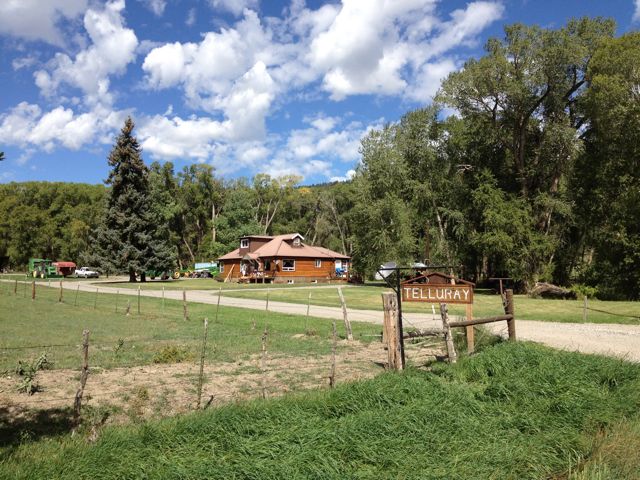
We pedal uphill for miles.  It never seems to let up, however the grade is not too steep, just continuous.  I have a one-speed 29” bike, not too fast, but a ton of fun.  Now to the north is Charlie Ergen’s Telluray Ranch.  Charlie owns Dish network, if I remember correctly.  I think I have a “Dish” dish on the house I’m buying. 
 
 Anyway, it’s beautiful country.  The green grass is at its height, and several tractors and mowers are cutting the hay and bailing it for the winter. 
As we make uphill progress, Nori asks where all the cattle are then answers her own question:  Probably still in the high country she says.  Just then a caravan of cattle trucks heads down the road in our direction kicking up a cloud of dust.  We pull off to the side of the road to let them all pass by.  Hunting season has started, and no self-respecting rancher would leave his cattle in the high country while the entire state plus most of Texas is carrying rifles and trying to shoot a deer or an elk.  When I was a kid in Utah, there were billboards with a picture of a cow and a picture of a deer, both labeled so ‘Foreigners’ (Texans) would know the difference.
 
As CR 24 intersects with the highway, the sun is now high, sweat has soaked my cycling clothes, and our legs seem to know it is time to turn around.  We still have an hour to get home.  The view back is different but even more inspiring.   
 
To the south the 14,150’ Mount Sneffles and the San Juan mountains line up along the horizon.  To the east, the direction we are now heading, the Cimmaron range with Chimney Peak and the Citadel cover the skyline.  I stop often for pictures, but wonder why.  This is now my home, and I don’t need to capture it all in a camera.  I can come back tomorrow.

Monday, July 9, 2012

Descent Into The Black Canyon

Saturday, my friend Nori and I drove out of the rain in Ouray and Ridgway heading for sunnier climes: The Black Canyon of the Gunnison river, just east of Montrose, Colorado, appeared to be warm and sunny.  It was a fine goal.  I flashed my Golden Age Passport at the park entrance station (I always hated the name Golden Age; who thinks up these things???)  Nori asked Maureen at the information desk to suggest a hike.  The normal trails seemed to ramble through the scrub oak.  We wanted to descend into the canyon.  This involved getting a "Wilderness Permit" just to scramble to the bottom.  Hmmmm!  Maureen described the descent in excruciating detail and made us sign the permit that we would be our own rescue team, wouldn't steal from the park, etc.  Then we headed down the route...not a trail, according to the Park.

 Nori peeks over the edge and starts down

It coursed for a few hundred yards through the scrub oak, then dropped precipitously through the Douglas fir trees into an 1,800-foot scree and boulder pile straight to the Gunnison River.  As we scrambled, signs warned us to go no further without the required permit.  Hmmm!  We had the permit.
 The Black Canyon opens in full splendor

My daughter Daphne had given me a Sony Bloggie camera for father's day.  I became a nuisance to Nori stopping often to capture a scene.  To a rock and mountain climber, this is heaven. Huge rock walls composed of pre-Cambrian gneiss and schist.  Threading through the rock were enormous seams of lighter pegmatite containing giant crystals of quartz, feldspar, and mica snaking through the darker bedrock.  As we hiked, we spotted large chunks of white quarts lying among the dark schist.  
 We spy the river below

Nori was having a blast, being careful and admiring the National Park's scenic wonders.  She made the obligatory complaints that this was hard and scary, but continued down undaunted.  About a third of the way down the "trail" drops precipitously for about a hundred feet, and the park service has graciously affixed a logging chain to a tree for a handhold.  I wished they had spent their effort making a short switchback here to prevent the erosion and increase the safety.  Down we slithered.
 The dreaded chain down the nearly vertical dirt and rocks

Looking across at the cliffs on the other side we gauged our progress in thirds.  It was a furnace with little cloud cover, so we stopped at each third and drank from our water bottles.   The Black Canyon is a popular venue for rock climbers, but the routes are extremely difficult, so only the very skilled climbers venture down to the bottom.  It is the opposite of mountain climbing where a climber ascends the mountain, then descends on a rope.  Here the climbers descend gullies and rappel on the ropes, then climb out to the canyon rim.
 Half way down, we look across at the sheer rock walls

The dirt and bushes turned to scree hanging on the angle of repose.  We carefully placed out feet on the larger rocks to avoid dislodging them and sending a rockslide down the gully onto others.  These rocks are old, metamorphic rock, created in a molten state about 1.7 billion years ago making them some of the oldest rock in the country.   About 70 to 40 million years ago, the entire area was part of the Laramide uplift.  Somewhere around 26 million years ago huge volcanoes drenched the landscape in deep lava.  
 The route angle lessens near the bottom

Then, as recently as 2 to 3 million years ago, the region uplifted again, and the west-flowing Gunnison river quickly cut a channel down to the old bedrock.  Currently it is eroding down at a rate of  one inch per hundred years.  Extremely quickly in geologic time.  It is the 5th steepest river in North America, with an average drop of 34 feet per mile.  We could see the rapids everywhere.
 Nori descending

Once at the river, the scenery changed: willows, alders, a few pines, grass, and poison ivy abound.  
Maureen in the Visitor Center had warned us not to drink the water or swim in in: too cold!  Hmmmmmm!  It looked fine to me.  The only reason I didn't jump is was because two fishermen were trying to catch the wily trout.  Being from Alaska this looked and felt like the tropics.
 The Gunnison River

We took a tour downstream and talked to a young couple who were working in North Park (north of the famous South Park!) at a National Wildlife Refuge.  Everyone we met was happy...almost.  I think a girlfriend talked her boyfriend into it, and he was no so gleeful.
 The happy camper at the bottom

We found shade under a tamarisk and ate some nuts and raisins, gulped more water, and prepared for the climb out.  We were surrounded by high canyon walls, and the only exit was the way we had descended.  We bet it was faster and easier to climb up frontwards than to climb down facing out.  Hmmmm!
 Looking up about 2,000 feet to the north 

It was quite a feast for the eyes.  A few vultures flew ominously overhead.  I scouted out climbing routes and thought about bringing a fishing rod next time.  Although I didn't see anyone actually catch a fish, I know there are big brown trout in the river.
 Elegant towers loom over us

The climb out was easier, but tiring.  We looked up and saw huge storm clouds, the ones that were raining on me in Ouray in the morning when we left.  Up past the scree, up through the steep ravines, past the chain, and finally onto the final stretch to the visitor center to turn in our permit, proving that we had not been swallowed by the chasm.  
The lunch spot on a log at the river

One more hike off the bucket list!  It had been a fine day, and we had 'cheated death once more'.